Underneath It All by Amber J. Keyser
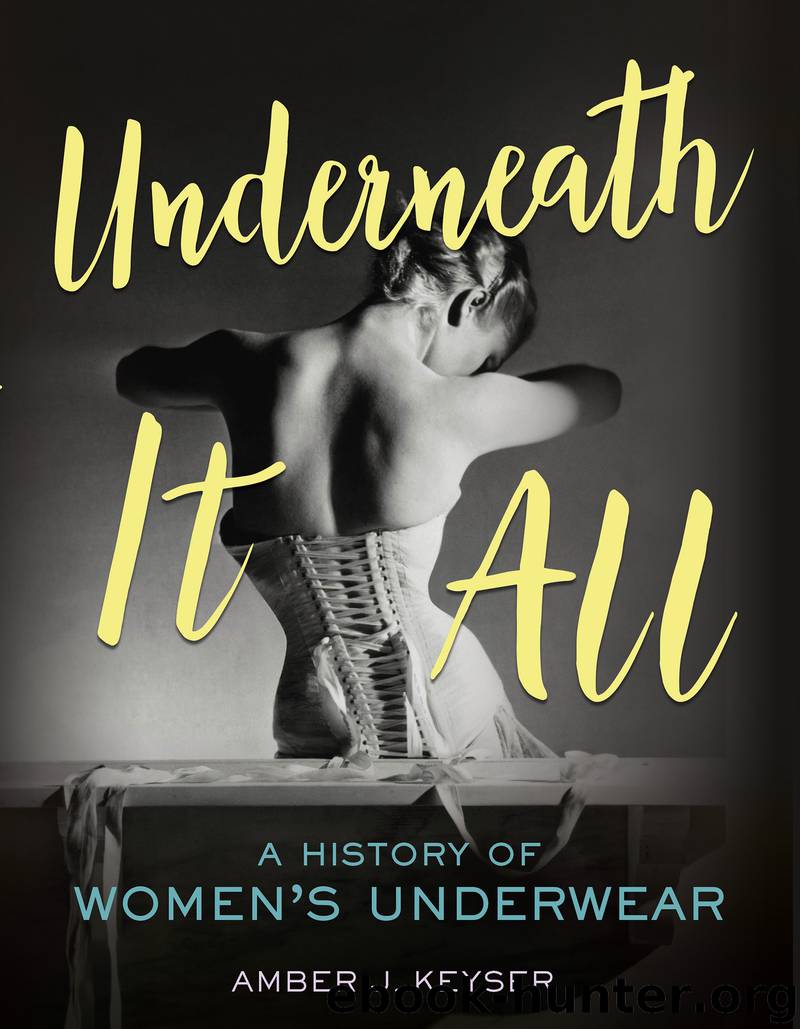
Author:Amber J. Keyser [Keyser, Amber J.]
Language: eng
Format: epub
Tags: A History of Women's Underwear, Accessories, Actors, Actresses, Advertising, Amber J. Keyser, Anthropology, Apparel, Beyonce, Beyonce Knowles, Body Image, Body Positivity, Bra, Brassiere, Clothing, Clothing Factories, Clothing Production, Corset, Corsetry, Corsets, Cultural Tradition, Culture, Customs, Dress, Edwardian Age, Fashion, Fast Fashion, Female Body, Femininity, Feminism, Feminist Movement, Feminist Theory, Film, Film Theory, Garment Workers, Gender, Gender Identity, Girdle, Girl, Girls, Girls & Women, Great Depression, History, Hosiery, Industrial Revolution, Invention, Invention and Technology, Jazz Age, LGBTQ, Lingerie, Madonna, Male Gaze, Manufacturing, Masculinity, Men's Underwear, Menstrual Cycle, Menstruation, Models, Nonfiction, Periods, Religion, Sexuality, Sexualization, Social Commentary, Social Studies, Suffragettes, Technology, Television, Textile Waste, Traditions, Transgender, Twenty-First Century Books, Undergarments, Underneath It All, Underneath It All: A History of Women's Underwear, Underwear, Victoria's Secret, Whaling, Woman, Women, Women's Bodies, Women's History, Women's Rights, World War I, World War II, Young Adult Nonfiction, Young Adults
ISBN: 9781541522077
Publisher: Lerner Publishing Group
Published: 2017-12-31T16:00:00+00:00
Sam Shaw took a series of famous photographs of movie star Marilyn Monroe during the filming of The Seven Year Itch in 1954. Posing on top of a New York City subway grate, she holds down her skirt as gusts of air blow from below. Monroe remains an icon of American female sex appeal.
Marilyn Monroe and other bombshells of the 1950s influenced a radical shift in lingerie advertising and marketing to average women. The earliest corset advertisements from the nineteenth century, for example, were in the back of ladies’ magazines. They were discreet pen-and-ink drawings with a two-dimensional depiction of the garment—the female form was not shown. In the early twentieth century, the Saturday Evening Post ran elegant oil paintings that advertised men’s and women’s undergarments, focusing on their practical use. By 1930 advertisers were using three-dimensional drawings of corsets shaped over seductive, hard-to-see, featureless female forms. Even though no flesh was revealed, the intended effect was to encourage the mind to “fill in the blanks.” In the late 1940s and 1950s, glossy full-figure photos of buxom Hollywood superstars such as Jane Russell and Betty Grable were used to sell everything from Coca-Cola to cigarettes to lingerie. Advertisers had shifted the focus away from discreet functionality and toward glamour, youth, and sex appeal.
In the 1950s, Maidenform was one of the largest lingerie manufacturers in the United States. The company launched one of the most famous bra campaigns in advertising history, with its “I dreamed” ads. With illustrations and eventually photographs, the ads placed women wearing Maidenform bras in a variety of settings, some ordinary though many fantastical. The successful ads purposely linked underwear with fantasies, revealing the secret inner lives of so-called stereotypical housewives. The ads featured women and their bras in the Wild West, at the opera, on flying carpets, and at construction sites. These ads hinted at the new dual role of lingerie—to make a woman feel great, adventurous, and fun—and to make her man think she was sexy.
Download
This site does not store any files on its server. We only index and link to content provided by other sites. Please contact the content providers to delete copyright contents if any and email us, we'll remove relevant links or contents immediately.
Pale Blue Dot by Carl Sagan(5008)
Cracking the GRE Premium Edition with 6 Practice Tests, 2015 (Graduate School Test Preparation) by Princeton Review(4294)
Pocahontas by Joseph Bruchac(4259)
Unfiltered by Lily Collins(4004)
The Emotionary: A Dictionary of Words That Don't Exist for Feelings That Do by Eden Sher(3365)
The Daily Stoic by Holiday Ryan & Hanselman Stephen(3322)
The 48 laws of power by Robert Greene & Joost Elffers(3291)
Factfulness_Ten Reasons We're Wrong About the World_and Why Things Are Better Than You Think by Hans Rosling(3237)
The Innovators: How a Group of Hackers, Geniuses, and Geeks Created the Digital Revolution by Walter Isaacson(3210)
The President Has Been Shot!": The Assassination of John F. Kennedy by Swanson James L(3102)
Sapiens and Homo Deus by Yuval Noah Harari(3071)
Rogue Trader by Leeson Nick(3044)
Gettysburg by Iain C. Martin(2835)
The Rape Of Nanking by Iris Chang(2824)
Almost Adulting by Arden Rose(2709)
The Plant Paradox by Dr. Steven R. Gundry M.D(2621)
In the Woods by Tana French(2599)
500 Must-Know AP Microeconomics/Macroeconomics Questions(2572)
Make by Mike Westerfield(2321)
